Stormwater systems often do their most important work when nobody notices them. During heavy rain, water flows across parking lots, roads, rooftops, and other hard surfaces, and stormwater infrastructure helps collect, slow, direct, store, and manage that runoff. Retention ponds and bioswales are important parts of many drainage systems, but they are not maintenance-free. Sediment, leaves, vegetation, trash, and other debris can accumulate over time and gradually reduce how effectively the system handles water.
For commercial property owners, HOAs, municipalities, industrial facilities, and property managers, regular retention pond maintenance and bioswale maintenance can help prevent drainage problems and protect the surrounding property. These systems are designed to manage large amounts of runoff, but they depend on clear pathways, adequate capacity, and properly functioning components to do their job.
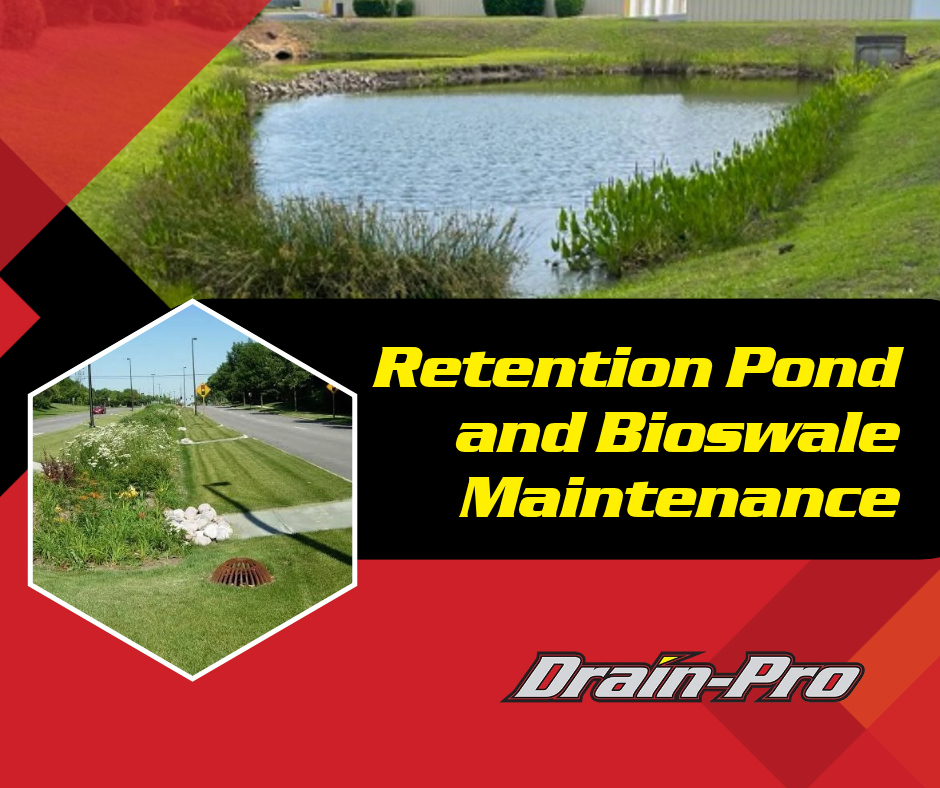
A retention pond is designed to collect and hold stormwater runoff. Depending on the design, the pond may maintain a permanent pool of water while still providing additional storage capacity during storms. Water entering the pond can carry dirt, sand, leaves, trash, oils, and other material from surrounding surfaces. As the water slows, some of that suspended material settles to the bottom.
That sediment accumulation is part of the reason retention ponds require maintenance. Over time, layers of dirt and debris take up physical space that was originally intended to hold stormwater. As the pond gradually loses capacity, it may become less effective during periods of heavy rainfall. Sediment can also move toward pipes, outlets, catch basins, and other structures connected to the drainage system, creating additional restrictions.
A bioswale works somewhat differently. It is generally a shallow, vegetated channel designed to receive and manage stormwater runoff. Instead of immediately sending water through a conventional pipe, a bioswale slows the flow and allows water to move through vegetation and soil. Bioswales are commonly found near parking lots, commercial developments, roadways, multifamily properties, and other areas with large amounts of pavement or other hard surfaces.
Healthy vegetation and proper drainage are both important to bioswale performance. A bioswale filled with sediment, trash, invasive vegetation, or standing water may no longer function as intended. Because these features often look like landscaping, property owners may not always recognize when maintenance is needed. However, a bioswale is more than a landscaped area; it is part of the property’s drainage infrastructure.
Stormwater maintenance is especially important in Washington and Oregon because of the region’s long wet season and periods of sustained rainfall. Fallen leaves, organic debris, saturated soil, and heavy rain can all put additional pressure on drainage systems. A stormwater facility that appears to function well during summer can behave very differently after several consecutive days of rain.
Leaves may collect over inlets, sediment may restrict flow, vegetation may become overgrown, and debris can build up around control structures. These issues are often discovered during a major storm, which is exactly when the system needs to be working at full capacity. Preventive maintenance allows property owners to identify and correct these problems before the wettest part of the year.
Visible changes can provide important clues that a retention pond or bioswale needs attention. Heavy sediment accumulation, excessive vegetation growth, trash around the pond, blocked inlet or outlet structures, erosion along banks, or water appearing in areas where it normally does not collect can all indicate maintenance issues. Property managers may also notice that stormwater takes longer to drain after rainfall or that standing water remains in places that previously cleared more quickly.
Bioswales can show similar warning signs. Large amounts of sediment on the soil surface, bare or eroded areas, excessive weeds, accumulated leaves, blocked entrances, or water that remains long after a storm may indicate that the feature is not draining as intended. Construction and vehicle activity can also affect bioswales. Compacted soil may change how water infiltrates, while sediment from disturbed ground nearby can quickly accumulate in the swale.
Retention ponds and bioswales also do not operate independently from the rest of the stormwater system. Water may reach them through catch basins, underground pipes, channels, culverts, or other structures. A problem in one part of the system can affect another. Cleaning a retention pond while ignoring clogged upstream catch basins may leave the larger drainage issue unresolved, just as a clean catch basin cannot compensate indefinitely for a downstream system that has lost significant capacity.
This is why effective stormwater maintenance should consider how all of the components work together. Drain-Pro’s stormwater services include cleaning sewer and storm drain systems along with catch basins, retention ponds, bioswales, retention vaults, and related infrastructure. Specialized vacuum and high-pressure water equipment can remove accumulated material from areas that cannot be adequately maintained with ordinary landscaping equipment.
It is also important to distinguish stormwater maintenance from general landscaping. Mowing, trimming, and removing litter can improve the appearance of a retention pond or bioswale, but those tasks do not necessarily address sediment buildup, clogged structures, or debris inside connected pipes. Likewise, changing vegetation or altering the shape of a drainage feature without understanding its purpose can affect how water moves through the property.
Waiting until standing water or flooding becomes obvious can turn a manageable maintenance issue into a larger project. Overflowing drainage systems can affect parking areas, landscaping, roadways, nearby buildings, and neighboring properties. Standing water can also interfere with normal use of a commercial property and create ongoing problems for employees, tenants, customers, or residents.
Regular inspection and cleaning allow property owners to identify accumulating material while there is still time to address it on a planned schedule. Maintenance records may also be helpful for commercial properties and facilities that have specific stormwater inspection or maintenance responsibilities.
Before the wettest part of the year, property managers should take time to check retention ponds, bioswales, catch basins, grates, drainage channels, and visible outlets. Look for sediment, fallen leaves, vegetation, trash, erosion, or signs that water is not moving through the property the way it normally does. It can also be helpful to inspect these areas after a major storm because heavy rain often reveals low spots, restrictions, and erosion that are difficult to see during dry weather.
Retention ponds and bioswales are easy to overlook because they often blend into the property around them, but they are working parts of the drainage system. Keeping them functional requires more than reacting when water starts pooling in a parking lot. Sediment removal, debris management, vegetation maintenance, inspection of connected structures, and professional stormwater cleaning all contribute to reliable performance.
Drain-Pro provides stormwater and Enductor truck services for commercial, municipal, and residential customers in Washington and Oregon. Specialized equipment allows crews to clean storm drains, retention ponds, bioswales, vaults, catch basins, and related infrastructure. If a retention pond is filling with sediment, a bioswale is no longer draining properly, or your property is experiencing recurring stormwater problems, evaluating the full drainage system can help determine where the maintenance need or restriction is located.
Stormwater systems work best when they are maintained before the next major storm puts them to the test.